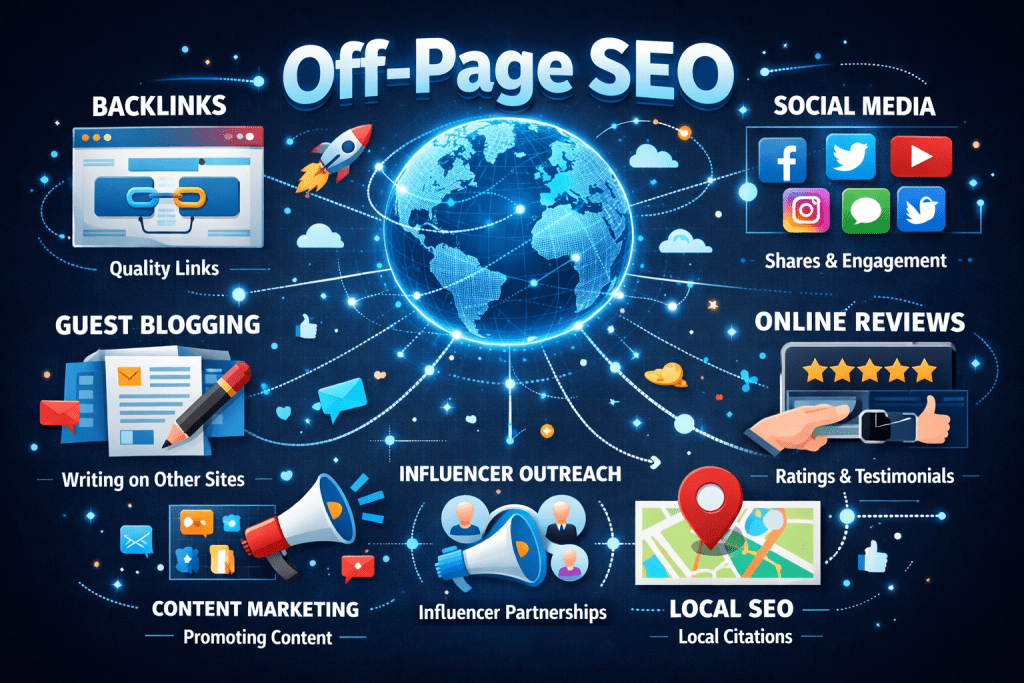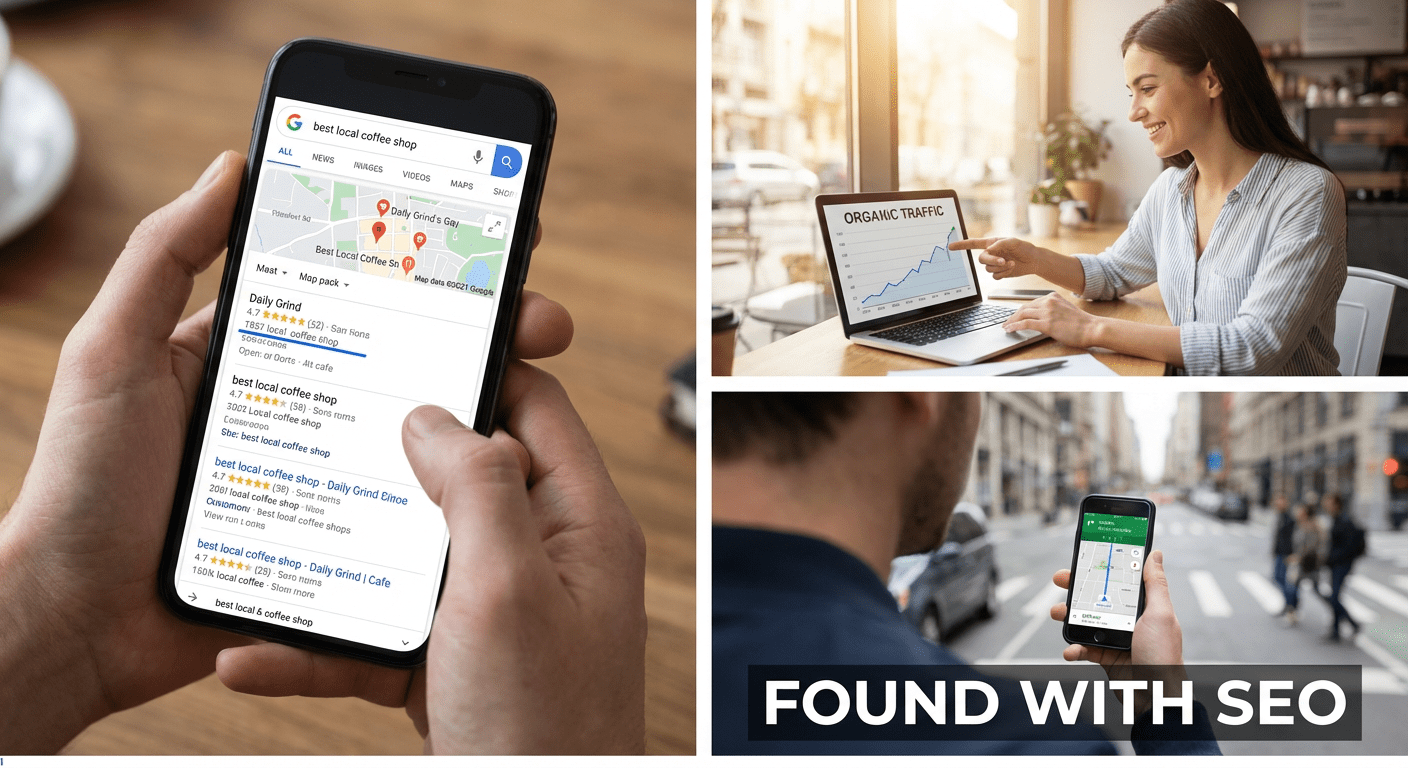
SEO, or search engine optimisation, refers to the process of enhancing your website's visibility on search engines such as Google and Bing.
With the help of Search engines, people get what they are looking for online. For instance, a student looking for answers to an assignment online, an individual looking for products online, or a traveller searching for the closest lodge online. There are so many things people come online to look for. With these SEO basics, you will learn how to fully optimise your website for search engines
WHY IS SEO SO IMPORTANT?
Increase website visibility and rankings
One of the most important functions of SEO is increasing visibility, making it easy for visitors to find you when they search for something you have to offer.
Visibility is directly related to your ranking in the sense that the higher your website ranks in the search engine results, the more visible it becomes to users. Conversely, if your website is not ranking well, it may not be visible to users, making it less likely to drive traffic and generate leads or sales.
Increase web traffic
Another important function of SEO is the fact that it boosts traffic when you have strong visibility and a high ranking.
According to Google Analytics, the average click-through rates (CTR) for the top three spots on the search engine results pages (SERPs) are as follows:
It is important to note that these figures are averages and can vary based on several factors, including the keywords used, the user's search intent, and the formatting of title tags and meta descriptions, among others. Additionally, studies have shown that more than 70% of search engine users are more likely to click on one of the top five suggestions in the search engine results pages (SERPs).
Building Trust and Credibility
Websites that rank at the top of search engine results pages (SERPs) are often perceived as high-quality and trustworthy. Results displayed on the first page are deemed the most relevant to users.
When a website appears at the top of SERPs, it signals to users that the site is:
i. Trustworthy: The search engine has evaluated the website as a reliable source.
ii. Authoritative: The website is recognised as an expert in its field or industry.
iii. Relevant: The website provides valuable content that aligns with the user's search query.
This enhanced credibility can lead to:
i. Increased conversions (such as sales, sign-ups, or downloads)
ii. Improved brand reputation
iii. Enhanced customer trust
iv. Competitive advantages over rivals
v. Increased engagement (including longer session times and more pages visited)
Focusing on Google E-E-A-T factors can enhance your website's trust and credibility with both Google and your target audience.
Enhance user experience (UX)
User experience is the overall experience that a user gets while engaging or interacting with a website.
SEO brings people to your website, while UX keeps them on your site longer and increases conversions
Here is how seo enhance user experience
a. User-friendly
Clear navigation and information architecture help users quickly and easily find what they're looking for. As a result, users tend to spend more time on your website, which lowers the bounce rate. This sends a positive signal to search engines that your content is high-quality and valuable.
b. Backlinks
When users have a positive experience on your site, they are more likely to link to it, effectively recommending your content to their audience. These links are known as backlinks. The quality and quantity of websites that link to yours can enhance your search engine ranking. Therefore, a good user experience (UX) can help you gain more backlinks
c. Page Speed Optimisation
More than 80% of people expect pages to load in three seconds or less; users have little tolerance for slow websites, making them leave your site without hesitation, leading to a higher bounce rate, which is bad for your site's SEO. Faster websites tend to have higher conversion rates. Google and other search engines prioritise fast-loading websites.
Google even offers a free tool called PageSpeed Insights, which measures your page speed and provides recommendations for improving it.
d. Mobile Friendliness
Mobile-friendliness means designing your website to be accessible and usable on mobile devices, such as smartphones and tablets. Given that people spend 70% of their internet time on mobile devices, having a mobile-friendly website is essential for improved navigation and user experience.
A poor mobile experience can result in high bounce rates. If your website is difficult to navigate on mobile devices, users are likely to leave quickly, which can lead to increased bounce rates and negatively affect your SEO. To address this issue, Google provides a free tool called the Mobile-Friendly Test Tool, which helps you evaluate how mobile-friendly your website is.
Reduce Marketing Costs
By achieving higher rankings in search engines, you can attract free and targeted traffic, which lessens the need for paid advertising or website promotion. Building a strong SEO foundation allows you to minimise your reliance on paid ads. While SEO is a long-term strategy and it may take time for your content to rank well on the search engine results page (SERP), optimising your content can help you reach the top and maintain that position. Although the SEO process can be time-consuming, it has the potential to generate significant amounts of traffic.
HOW SEARCH ENGINE WORK
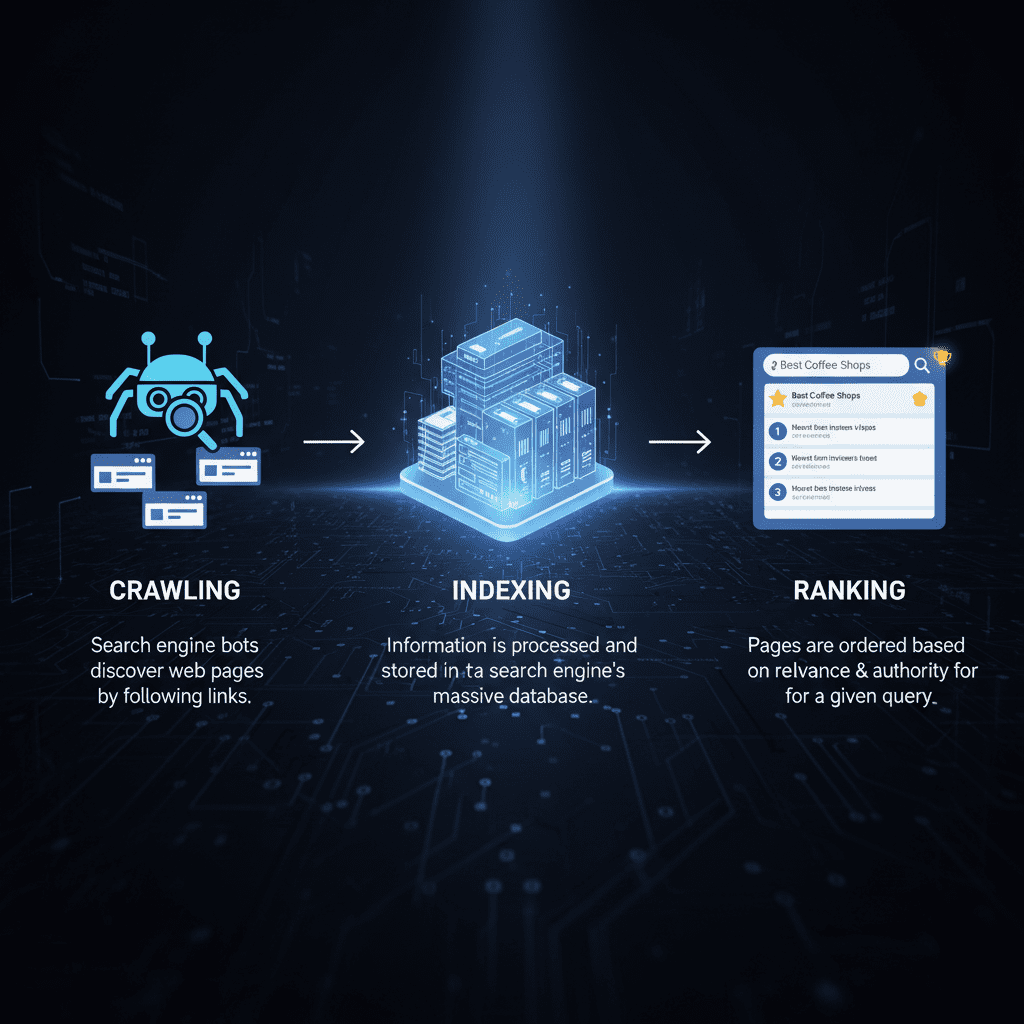
Search engines work by performing three main tasks: Crawling, Indexing and Ranking.
Crawling
Search engines use crawlers, also known as spiders or bots, to discover new web pages on the Internet. This process is referred to as crawling. To understand this, think of a librarian who searches for new books to add to a library collection, ensuring that visitors have access to fresh materials. Similarly, crawlers are programmed by search engines to look for new content, such as text, photos, videos, or webpages on the Internet.
Indexing
After web pages are discovered by crawlers, they undergo the next stage called Indexing. In this stage, all crawled content is being stored in the database. We can also apply the analogy of the librarian, who, after searching for new books, arranged them in a way that can be easily accessed by people looking for a specific book.
Ranking
The process by which search engines produce search results in response to a user query is known as ranking. Using the analogy of the librarian, when a patron asks for a book, the librarian recommends the most relevant among the books requested.
ELEMENTS OF SEO
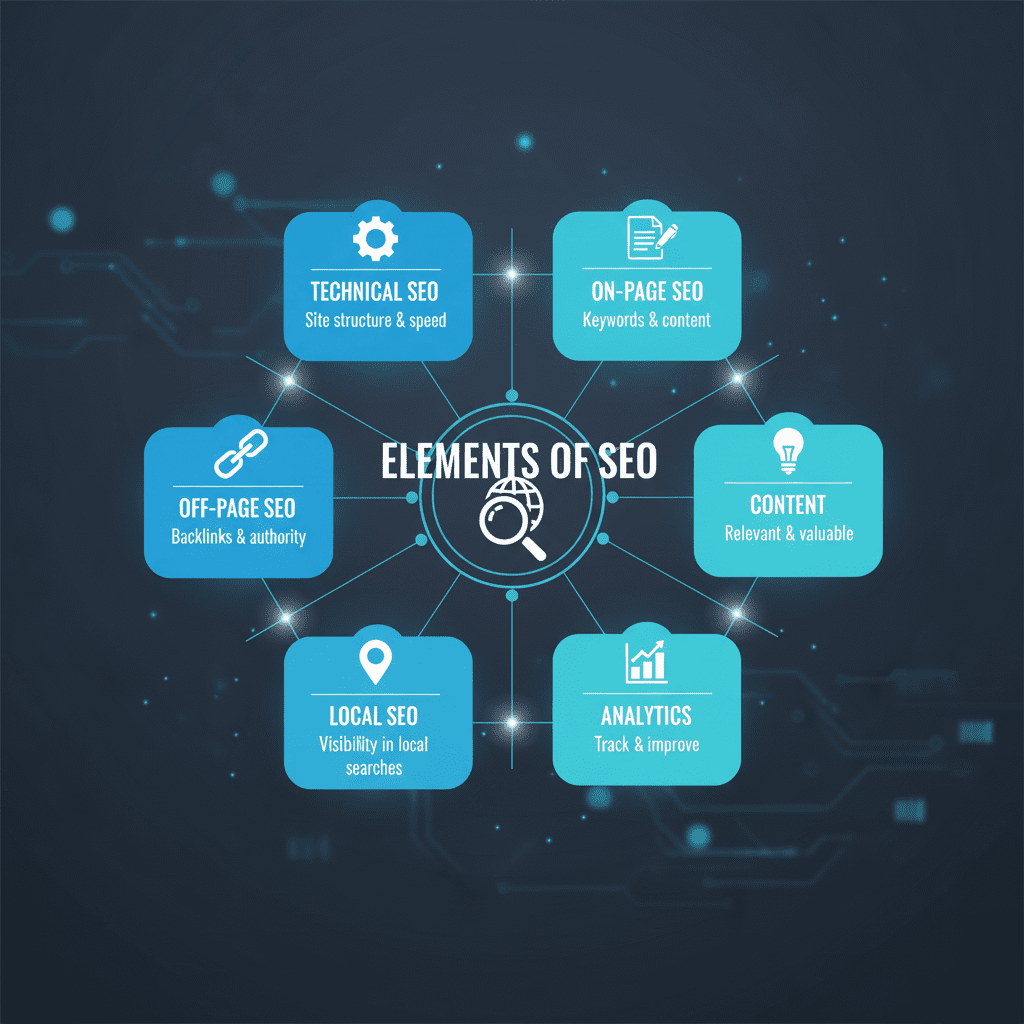
ON-PAGE SEO
TECHNICAL SEO (Some SEO experts consider Technical SEO as a subset of On-page SEO, but in this study, we will treat it as a separate category)
ON-PAGE SEO
On-page SEO, or on-page optimisation, also known as on-site SEO, refers to the practice of optimising various website components to aid search engines in crawling, understanding, and ranking pages for relevant queries. It also refers to the SEO components or elements you control on the webpage, such as content and many other things we would be discussing
ON-PAGE SEO FACTORS
- Content
- HTML
- Website Architecture
1. CONTENT
Creating content that aligns with the searcher's intent is very important for effective SEO.
Haven't you heard what they say about content? That CONTENT IS KING.
Content is the foundation of a successful SEO strategy.
Below are factors you need to consider to maximise content impact on your on-site SEO
- E-E-A-T
- Keyword
- SEO Writing
- Freshness
- Visual Assets
a. E-E-A-T: (Experience, Expertise, Authoritativeness, and Trustworthiness)
E-E-A-T: It's a framework that Google uses to evaluate the quality and credibility of online content.
Google aims to deliver search results that contain strong E-E-A-T in order to safeguard its users from any potential danger.
This is very important when it comes to Your Money or Your Life (YMYL) topics. These are topics that can affect users’ well-being. Such as health and finance.
Below is the breakdown of the elements of E-E-A-T
E- EXPERIENCE: This is the level of first-hand experience the content creator has on a particular topic or subject matter.
First-hand experience enables you to provide tried and trusted advice.
One key difference between an A. I generated content, and human-written content is EXPERIENCE.
Artificial Intelligence has no physical experience of anything. It can only make assumptions about human experience or create analogies, because it is not a human
Artificial Intelligence has no physical experience of anything. It can only make assumptions about human experience or create analogies because it is not a human.
Searchers regard content that is written with true-life experience (remember that you are writing based on the searcher's intent). Do not write for search engines, write for humans.
Would you take relationship advice from your friend who is single or from your friend who is married? Definitely the married one because the advice would be purely first-hand.
Searchers can know the level of your experience in so many ways:
- Use the ABOUT US page to share the summary of your background and accomplishments.
- Share success stories, highlighting challenges, solutions and results. And so many more.
- Showing your first-hand knowledge or experience through videos, images, and other forms of content.
E- EXPERTISE: This is the level of knowledge that an individual has acquired in a particular field, such as a writer or a content creator, a doctor, an engineer, etc.
Between a Chef and a food blogger, whose recipe is more trustworthy? Definitely the chef due to training and experience.
Searchers would prefer to visit websites where their writers are specialists on the subject matter they are searching for.
Such content is very authentic since it is written by people who have deep knowledge in that field, so researchers believe and trust such content more than the ones written by a generalist or non-expert.
You can showcase your expertise to searchers through many ways, including:
- Displaying your certifications and license
- Highlight your expertise on your homepage.
You could use the layout below
Example Layout:
*[Your Name]*
*Expertise*
*[Job Title]*, [Company Name] ( [Date] - [Date] )
- Brief summary of job responsibilities
- Key achievements (with metrics)
- Relevant skills used
- *[Project Name]* ( [Date] )
- Project overview
- Your role and responsibilities
- Outcomes and impact
A- AUTHORITATIVENESS: This is the extend at which a content creator is recognised as a legit source of information on a particular subject matter. It also represents your reputation within a subject matter.
Between the Doctor's prescription and your friend's advice on health medication, who is a gas attendant at a gas station, which would you take seriously? Definitely the Doctor's prescription. Authoritative content comes from a qualified expert.
When other websites are pointing to a page on your website, they are sending signals to search engines that the information on that page is legit.
Other websites need to give that vote of confidence to your website if you want to rank higher.
T- TRUSTWORTHINESS: Trust = Experience + Expertise + Authority.
This equation shows that trust is built by demonstrating Experience, Expertise and Authority.
b. Keyword
Keywords, as the name implies, are words or phrases that users type in search engines to find relevant content for their queries.
Creating content that includes the keyword (words or phrases) your target customers are searching for is vital.
Use your keyword throughout your content carefully without keyword stuffing. Placing them in strategic locations such as:
- Add your target keyword to your page’s URL.
- Use your keyword in your Page's title tag
- Meta description
- Head tags (H1, H2, H3 etc. )
- First paragraph
- Throughout your content.
c. SEO Writing
This is a technique of creating high-quality content with the aim of search engine optimisation in order to improve website visibility and rankings.
Seo writing is beyond just creating high-quality, engaging and informative content. Seo writing aims at optimizing contents to rank higher in search engine results pages (SERPs).
In seo writing, you have to use specific techniques and strategies in order to appease search engines.
Here are a few Characteristics you need to focus on when writing for seo.
- keyword research: you have to identify and use the right keywords and phrases that people are searching for, and be able to use them appropriately.
- Content structure: your content should be user friendly i.e it should be easy to read, understand and navigate. You can achieve that by organising your content with headings, subheadings and paragraphs.
- Internal and external linking: linking to relevant and authoritative sources to increase webpage credibility.
More of the characteristics are:
- meta tags and description
- content freshness
- mobile friendliness and accessibility.
(They will be explained in the course of this study)
d. FRESHNESS
Endeavour to keep your content fresh and updated. Search engines like Google appreciate and reward content freshness, and that is why it has a great impact on search engine rankings.
Tips for keeping your content fresh
- Regularly update existing content
- Publish new content regularly
- Encourage user engagement. This could be achieved through asking for feedback and responding to comments.
- Stay up to date with the industry trends.
e. VISUAL ASSETS
Visual assets are digital elements that are used to communicate information on websites, social media and other digital platforms. It also enhances the website's user experience and, when optimised properly, can increase search engine ranking and visibility.
Visual assets make your content look more attractive to your viewers. For instance, reading a novel with no pictures can be a bit boring for most people, but it becomes more enticing to read when there are pictures that convey meaning. It's also applicable to the website; your content is more exciting when you attach pictures, videos, charts or any appealing visuals. The importance of Visual assets cannot be overemphasised.
By optimising these visual assets, you can improve your website's visibility in search engine result pages (SERPs), drive more traffic and enhance the user experience.
2. HTML: HyperText Markup Language(HTML)
HyperText Markup Language(HTML) is the standard markup language used to structure your webpage and content. It enables search engines like Google understand what your content is all about and then categorise it. HTML also improves how visitors view your website. By optimising your HTML for SEO, you can improve your website's visibility, drive more traffic, and increase your online presence.
HTML tags that you should consider when optimising your HTML for SEO
- Title Tags
- Meta Description
- Image Optimization
- Geotagging (for local search)
a. Title Tags
This is one of the most important HTML tags for SEO, because it helps search engines understand the content and relevance of the webpage. It is a piece of HTML code used to define the title of a webpage. The title tag is what users click on in the SERP to visit your website. By crafting effective title tags, you can improve the visibility and click-through rate of your webpage in the SERPs. A captivating title tag will generate more clicks than one that is boring and uninteresting.
Well-written title tags should be:
- Accurate and descriptive of the webpage content
- Concise and within the recommended character limit (55-60 characters)
- Unique and distinct from other webpage titles
- Relevant to the target keywords and search query
b. Meta Description
The meta description is a short summary of a webpage's content that appears on the SERPs, usually beneath the title tag. Its aim is to provide a concise description of the webpage content, enticing users to click through to the page.
Well-written meta Description should be:
- Brief: To prevent truncation, keep the meta description between 155 and 160 characters.
- Descriptive and Accurate: Webpage's content should be summarised accurately.
- Keywords should be used strategically, and make sure you avoid keyword stuffing.
- Use a unique meta description for each page to avoid duplicates, which can lead to confusion.
A well-optimised meta description helps search engines understand your content, thereby improving your click-through rates CTRs.
c. Image Optimisation
Image optimisation involves the technique of creating and delivering high-quality images.
As discussed earlier, the importance of Visual assets when optimised cannot be overemphasised.
Best practices for image optimisation.
- Image resizing: Image size refers to the dimensions of an image (e.g, 1920 pixels by 1080 pixels). Images with higher resolution and larger dimensions slow your page load times. Images should be scaled to the desired sizes to reduce file size. Larger file size, especially image can slow your webpage load time because a larger file size takes longer to download, slower load time can lead to a higher bounce rate as users may become impatient and leave your site. Search engines like Google consider page speed as a ranking factor, which means slow load time can negatively affect your SEO.
- Optimize image file names: Use descriptive file names (i.e, the name of the file should accurately describe the image ) and include the target keyword in the file name, separate them with the help of hyphens. Customise file names instead of using something like IMG_09125
- Use alt tags: The Search engine spiders (also known as bots or crawlers) cannot interpret and understand the content of an image like humans do. They rely on text-based clues such as the alt text to understand the image's context and relevance. The alt text is displayed when the image cannot be loaded due to a glitch. The alt text can also be accessed by screen readers, which can be very helpful to visually impaired users.
Alt tags help provide search engines with the text description of an image, which can improve image search rankings.
Other practices for image optimisation include
- Choose the right image format
- Make images mobile-friendly
- Optimise the image title
- Use unique images
d. Geotagging (For Local Search)
This is the process of adding geographic metadata, including latitude and longitude coordinates, city, state or country names, and other location-specific information to digital content like images, videos, and web content. It enables these digital contents to be precisely located, allowing the users to search, filter and organise content based on geographical tags.
Geotagging is a powerful SEO strategy for small business owners, very useful for local businesses with a physical location.
For instance, there is a traveller in Nigeria who has not reached his destination and is stuck in Kaduna State in the middle of the night; geotagging can help such a traveller find nearby hotel accommodations. Geotagging helps business owners in a specific location optimized for to be located easily.
3. WEBSITE ARCHITECTURE
Website architecture refers to the way you categorise, structure, and interlink your website's content, pages, and features to create a cohesive and user-friendly experience.
A well-structured website architecture enables search engines to understand the content and relevance of your website, which improves your search engine rankings and drives more traffic to your website.
Factors to consider when optimising your site’s architecture:
- Siite Speed
- Responsive Design
- URL Structure
- Internal Linking
a. Site speed
A slow-loading website has negative effects on user experience in the sense that It frustrate and drives away visitors, leading to a higher bounce rate. It also affects search rankings, since Google have confirmed that page speed is a ranking factor.
- Always compress and optimise images; it helps reduce file size, which can increase page load times.
- Remove unnecessary code and minify HTML, CSS and JavaScript files to reduce file size
- Implement caching
- Use a content delivery network CDN
b. Responsive design
Responsive design refers to the approach of creating and designing websites that adapt and respond to different screen sizes, devices and orientations. It is a crucial factor in optimization website's architecture. Users should be able to access your website using all kinds of devices. A responsive design ensures that your website provides an optimal user experience across various devices and orientation helping users to easily navigate and find the information they need.
c. URL Structure
A URL structure must be SEO-friendly, concise, readable, and use relevant keywords. It enables users and search engines understand the content of a page. A well-designed URL structure can improve user experience and search engine ranking.
Best practices for URL structure
- Use lowercase words.
- Join words with hyphens and not underscore
- It should be descriptive and concise
- Avoid special characters and numbers unless it is absolutely necessary
d. Internal Linking
This refers to the process of linking one page on a website to another page on the same website. It is a crucial factor in optimising website architecture. Internal links help search engines find your content easily.